general
Partial derivatives and the cross product?
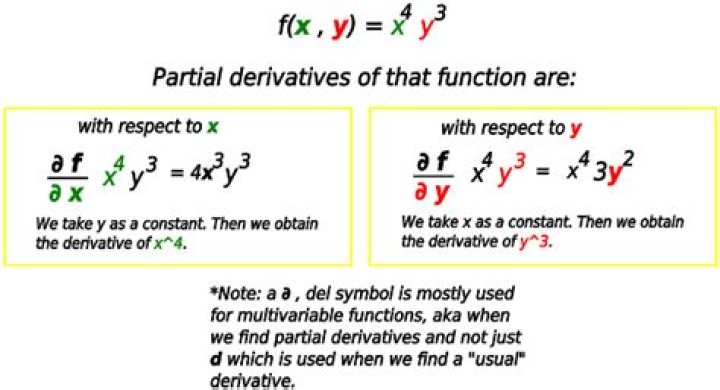
I have a unit vector $$\hat{r}(x,y)=\left(r_1(x,y),r_2(x,y),r_3(x,y)\right)$$ and its partial derivatives $$D_x \hat{r}(x)=\left( D_x r_1(x,y), D_x r_2(x,...
Apr 11, 2026
Bright entertainment trends with youth appeal.
I have a unit vector $$\hat{r}(x,y)=\left(r_1(x,y),r_2(x,y),r_3(x,y)\right)$$ and its partial derivatives $$D_x \hat{r}(x)=\left( D_x r_1(x,y), D_x r_2(x,...
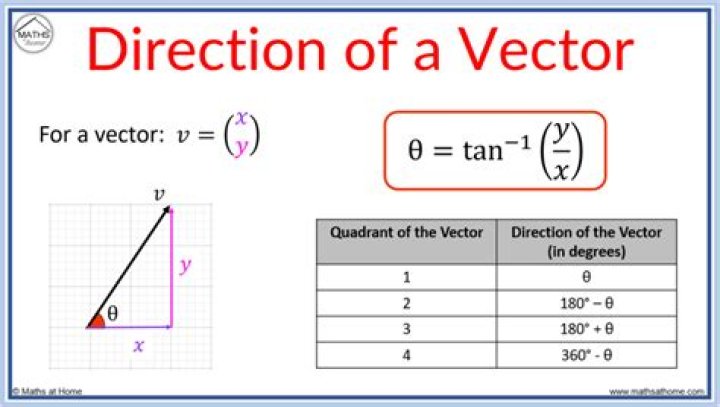
So when I am working on homework and I am asked to find the direction angle of a vector. I usually do the inverse of $\tan(y/x)$. Whatever answer I get, I...

By chance I noticed that $e^{-1/e}$ and $\ln(2)$ both have decimal representation $0.69\!\ldots$, and it got me wondering how one could possibly determine...
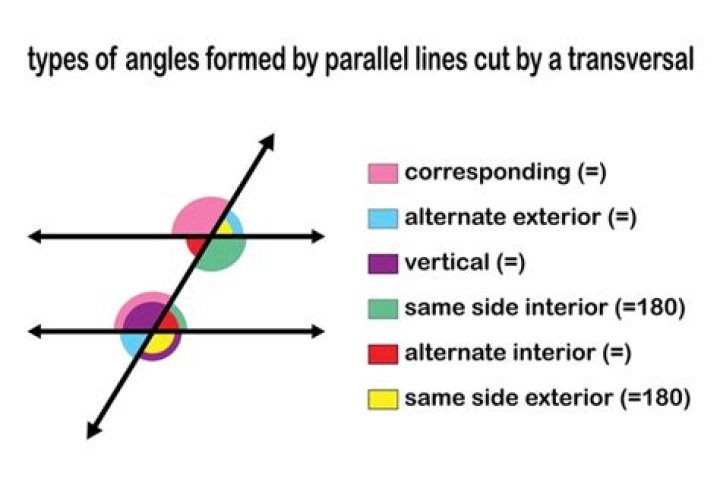
My teacher told me that two parallel lines have a point of intersection, it is called Point at infinity. But I I can't understand how it can be true ...
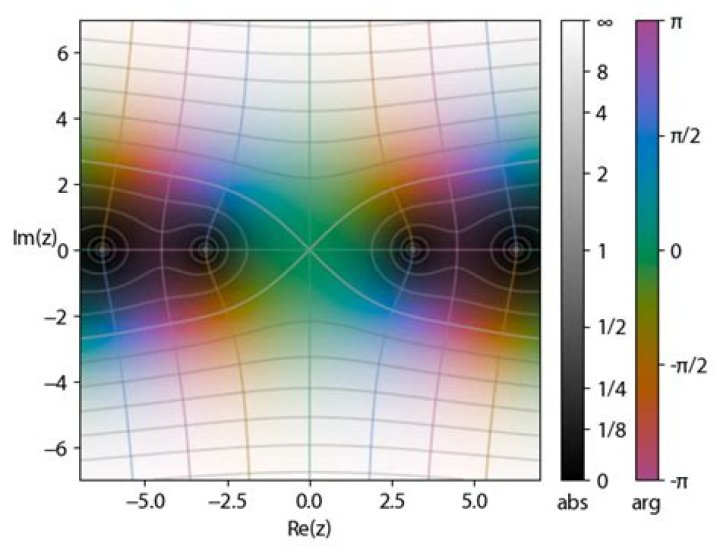
I want to know the exact method of plotting complex function used by human, computer, and whatever who can do mathematics. For example how should I plot t...
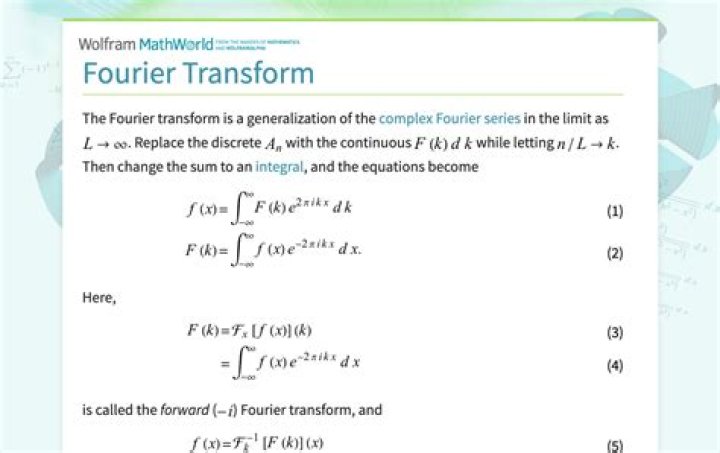
Consider a function $f(t)$ with Fourier Transform $F(s)$. So $$F(s) = \int_{-\infty}^{\infty} e^{-2 \pi i s t} f(t) \ dt$$ What is the Fourier Transform o...
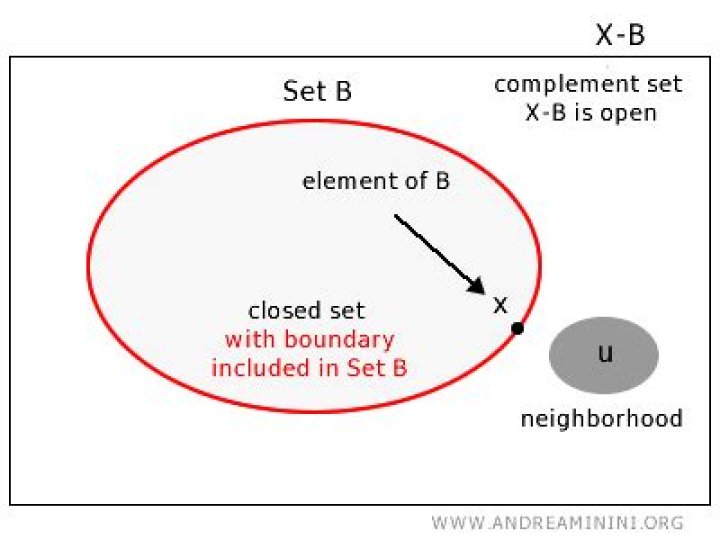
Let $X$ be a topological space and $N$ a subset of $X$. I want to show that $\partial \bar N\subset \partial N$. I know that since $\bar N$ is closed then...
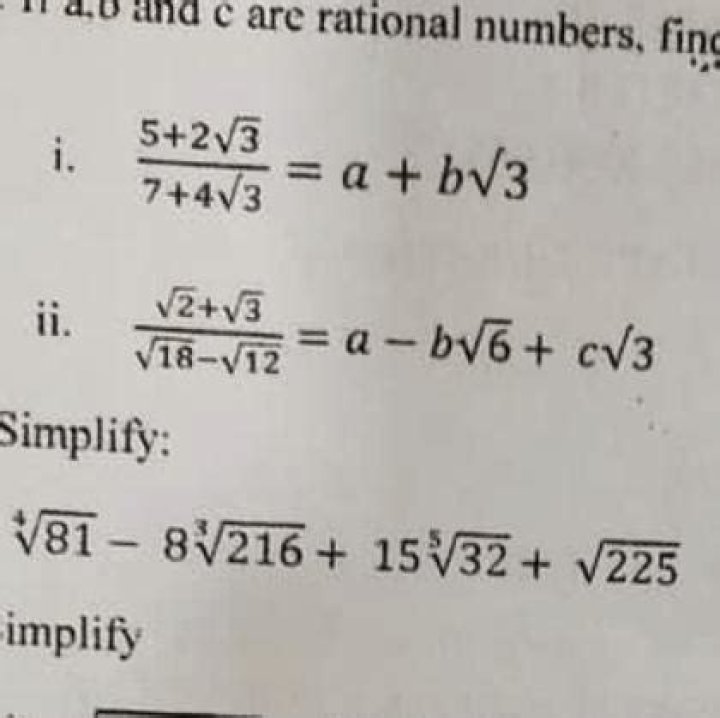
So far I've reasoned that $\mathbf{a}$ and $\mathbf{b}$ can't be both negative, because $\sqrt{21-12\sqrt{3}}$ cannot be negative. Also $\mathbf...
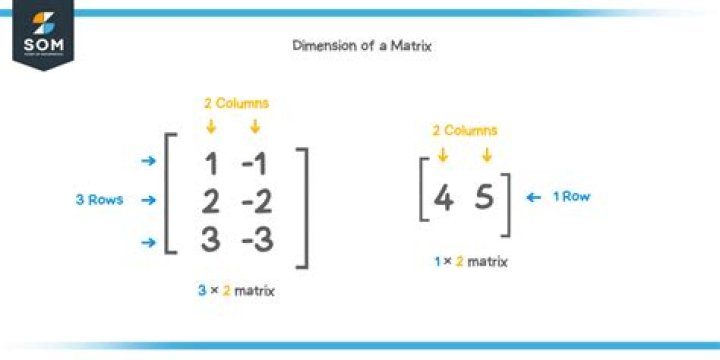
Consider a vector $v$. The magnitude of this vector (if it describes a position in euclidean space) is equal to the distance from the origin: $$(v^Tv)^{\f...
Let $a,b,c $ are non-negative real numbers, and $a+b+c=3$. How to prove inequality $$ ab^2+bc^2+ca^2\le 4.\tag{*} $$ In other words, if $a,b,c$ are non-ne...
